What soft-body means in sobosuba
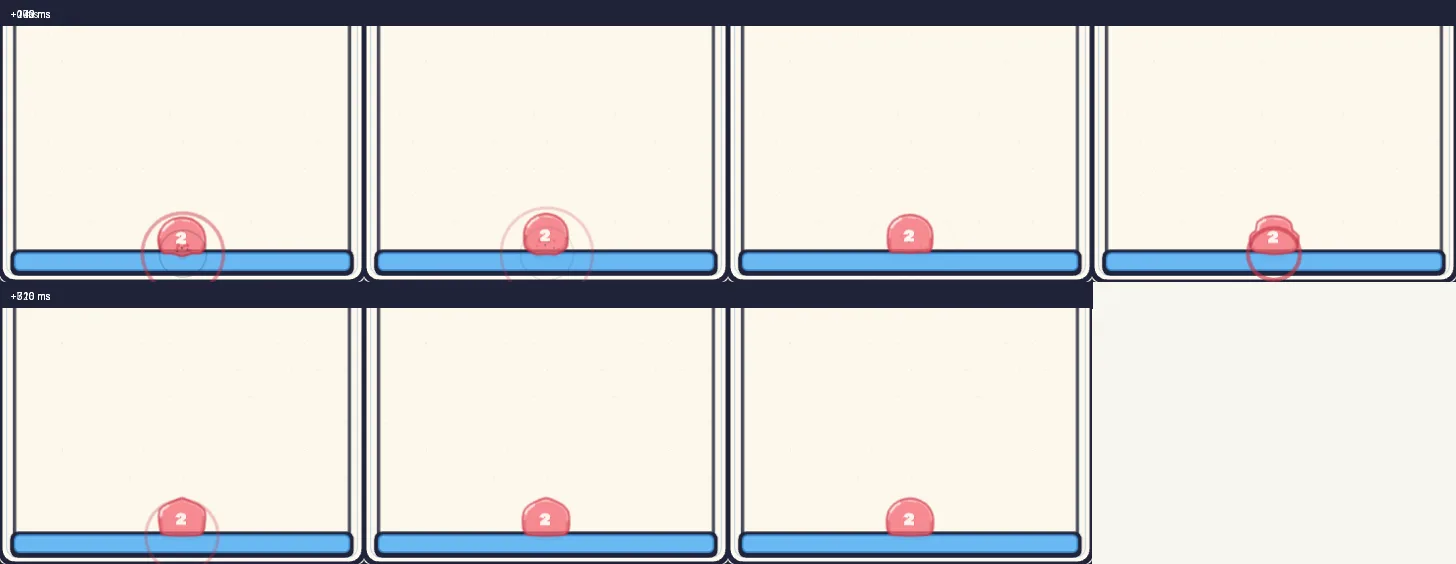
A rigid merge game can represent every piece as a circle. The circle may bounce and roll, but its collision boundary never changes shape. In sobosuba, a jelly is built from connected particles. When it lands, those particles move relative to one another: the lower surface flattens, the sides spread and the upper surface follows.
That deformation is part of the simulated body. The shape you see helps determine where the jelly touches the floor, a wall or another jelly. This is important because a soft contact can create a wider support area than a rigid point contact. It can also briefly fit through a space that looks too narrow when the jelly is at rest.
Practical meaning: aim predicts the opening direction, not the final resting place. The pile deforms after impact, so force, support and nearby motion complete the shot.
Compression and rebound
When a jelly hits the floor, downward motion cannot continue through the boundary. The lower particles slow first while the upper particles still carry momentum. The body becomes shorter and wider, stores energy in its internal constraints and then releases some of that energy as rebound.
A gentle landing has less stored energy. The jelly flattens slightly, makes a broad contact and settles close to the impact point. A hard landing compresses more, spreads farther and rebounds higher. This is why a maximum-strength shot may jump over a matching value even when the initial aim looks correct.
Collisions between two jellies follow the same principle in a moving frame. Both bodies can deform, so the contact transfers motion through a changing area rather than a fixed circular edge. A direct hit may push the target, while an angled hit can create rotation and a traveling wobble.
Support load and pile behavior
A jelly at the bottom of the pile carries weight from the pieces above it. That load changes its shape: it becomes a broader base and may develop a local dent where another jelly presses down. The supported pieces respond in return. Together they form a network that distributes force through multiple contacts.
This explains why a shot on one side can move a jelly somewhere else. The impact compresses the first contact, then that force travels through its supports. A prepared pair may be nudged together, or a carefully balanced top value may roll away because its base changed shape.
For strategy, low merges are powerful. Removing or replacing one support changes the load above it, allowing the pile to settle downward. The same movement can trigger a chain when two prepared values lose the object that separated them.
Friction, rolling and narrow gaps
Friction resists sliding at a contact. A jelly resting on a broad flat area is harder to move sideways than one touching at a small rounded area. On a slope, gravity may overcome that resistance and make the body roll or creep toward a lower pocket.
Deformation changes this balance during a shot. A compressed jelly can widen, catch against a wall and slow down. It can also narrow along one axis and slip between two supports. The result depends on the angle and timing of contact, so two visually similar shots may settle differently if the pile is still moving.
Use this behavior rather than fighting it. Place gently onto a slope when you want gravity to finish the route. Use a firmer impact when you need temporary compression to reach behind an obstacle. Avoid hard glancing shots against the wall, where rebound can send the jelly back across the upper board.
Wobble and traveling waves
After impact, not every part of a jelly returns to rest at the same moment. Motion travels around the outline as a damped wave. A bulge on one side may be followed by a smaller response on the other side. Internal damping gradually removes energy so the body does not wobble forever.
The visible wave is also useful feedback. A strong oscillation means the contact network still holds energy. Releasing another shot immediately can combine that motion with the new impact and produce a larger rearrangement. Waiting for the wave to decay gives a more predictable placement.
What happens during a merge
Equal values need a valid contact before they combine. At the moment of the merge, the two bodies are replaced by the next value around their shared contact area. The new body inherits the local situation: nearby supports, remaining motion and available space all influence how it expands and settles.
A merge therefore does more than remove one object. It changes the size and shape of a contact region. A new larger jelly may press outward, lower the pieces above it or touch another matching value. Those secondary effects are the physical foundation of a sobosuba chain.
Leave room around prepared pairs. If the contact point is tightly enclosed, the merged jelly has fewer directions to expand and can push upward. A little side space helps the result settle lower and reduces danger-line pressure.
Settling and simulation sleep
As motion decays, the game treats sufficiently calm bodies as settled. This keeps a quiet pile stable and avoids spending work on invisible micro-movement. A new collision can wake the affected area, returning those jellies to active motion.
From a player's perspective, the important distinction is between a pile that looks almost still and one that has truly finished transferring force. If accuracy matters, give the board a brief moment. If a prepared chain is already unfolding, avoid interrupting it with the next release.
Quality and reduced motion
The quality setting controls visual detail and rendering cost. Reduced motion limits presentation such as camera movement and particles. These settings do not replace the underlying pile with rigid pieces, so the same strategic ideas still apply: soft placement, loaded supports, compression and rebound remain part of the game.
For practical application, return to the sobosuba strategy guide. For the basic control sequence and value rules, read how to play sobosuba.